ELIZABETH'S BLOG
A Great-Granddaughter's Legacy

A Lost Painting Found in an Old Polish Zionist Newspaper

Chanuka

Chanuka

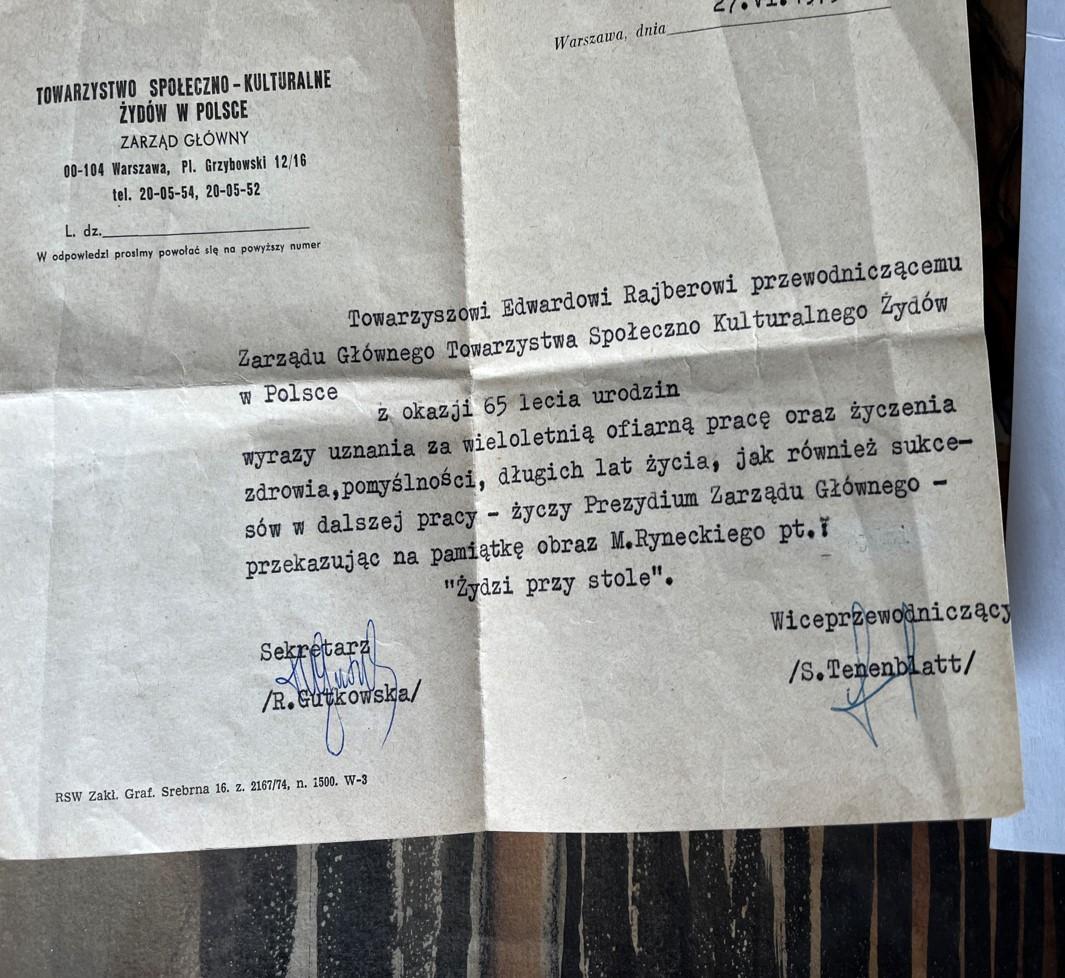
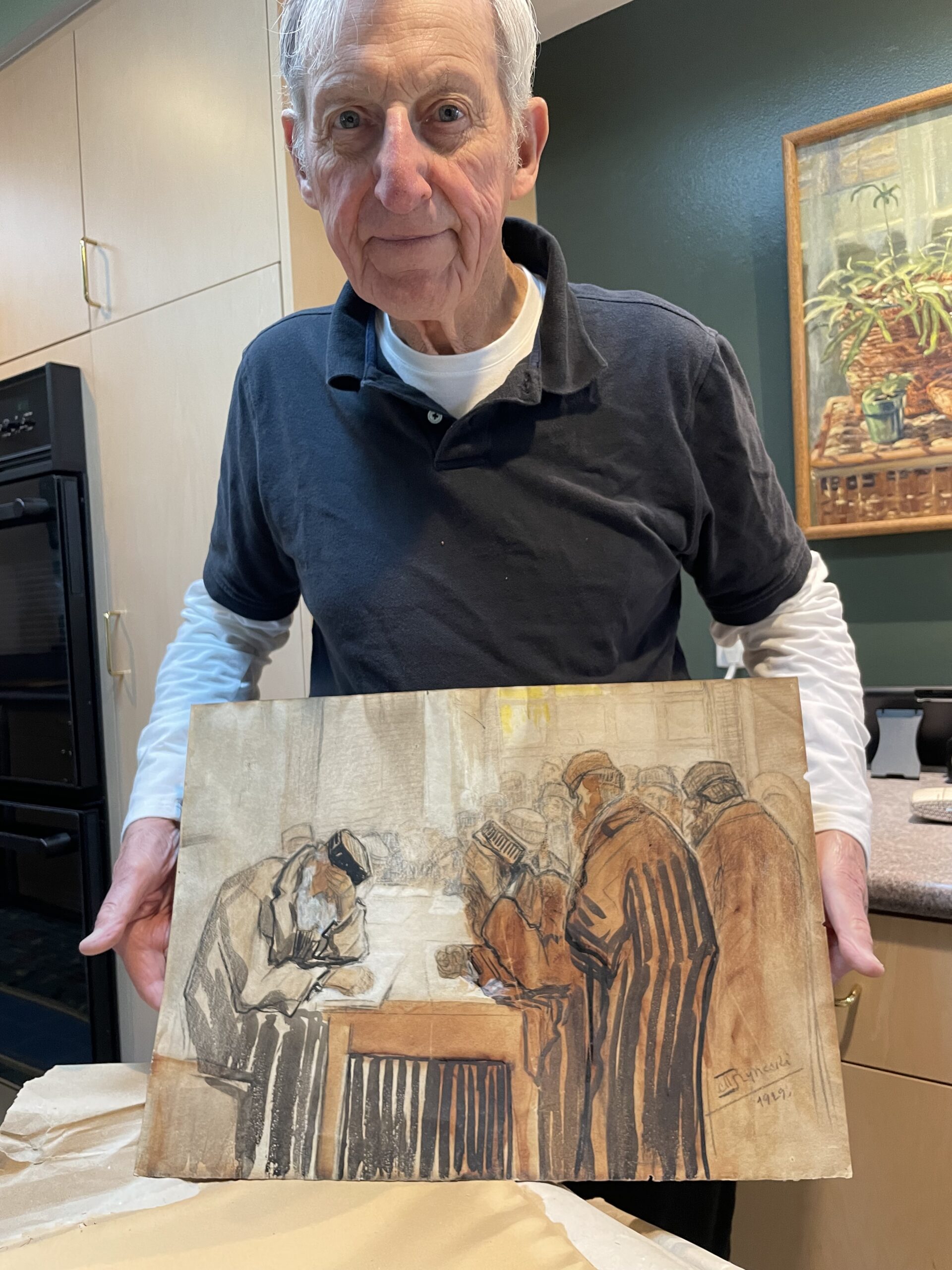
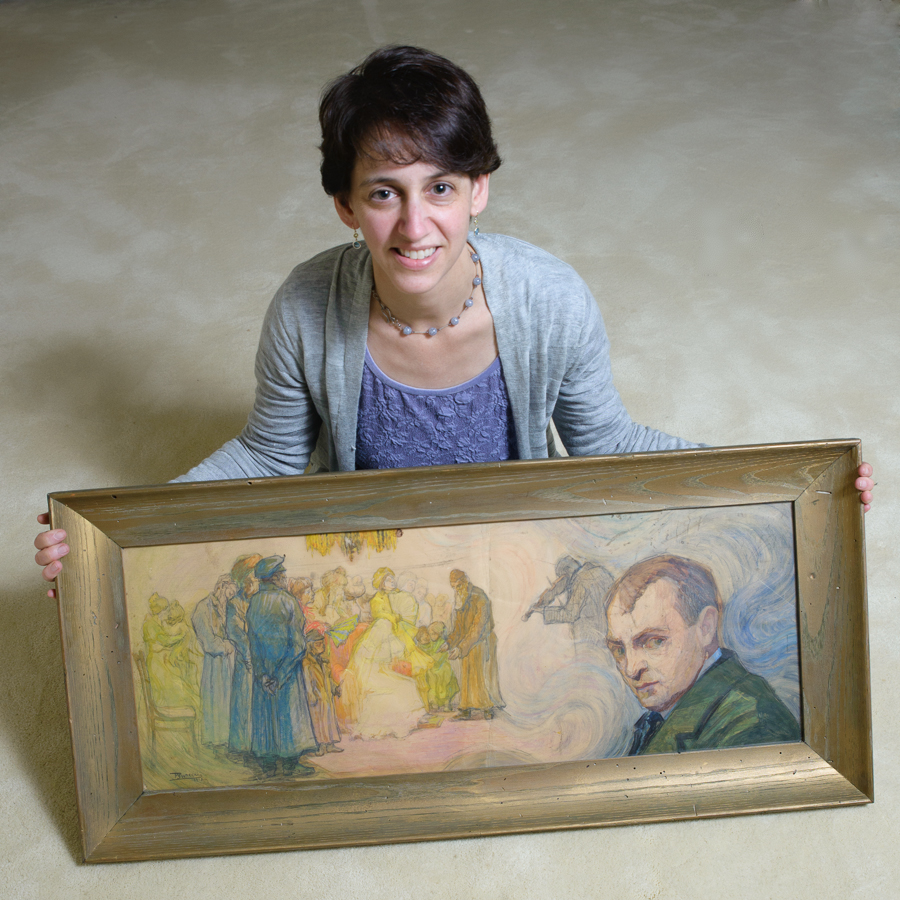
WOW! So I have a story to tell. In April 2012 I learned of an article in Polish all about my great-grandfather. A friend in Finland had a friend in Poland who offered to read it (it was just too long for me to type into Google Translate) and to let me know if it said anything significant. It did. The footnotes mentioned a newspaper, a Polish-language Zionist daily published in Warsaw (1923-1939), titled: Nasz Przegląd (Our Review) and a special insert section called Ilustrowany (illustrated). The article’s footnotes said it contained images of some of Moshe’s works. I tried to find the publication in the States: no luck. A relative in Israel tried to get it: no luck. A year later I gave a talk in Davis. I met a woman who knew a Fulbright scholar in Poland. She said he could help me. He did. I have just received an email with three images from that paper. Two I’ve never seen before. This one is titled, “Chanuka,” and says below it: composition by M Ryneckiego (a Polish conjugation of Rynecki). The title across the top translates, I believe, to Light Maccabees. I have absolutely no idea if this painting survived WW2 and if so where it might exist. It’s the latest example (and reminder) that if I keep searching and keep telling my story, that I will learn more.

In case you’re interested, the publication and reference information found in the footnotes is as follows:

The footnote numbers, with the Polish first and the Google Translate following:
9:  Przede wszystkim w “naszym przegladzie ilustrowanym” tygodniowym dodatku do ukazujacego sie w Warszawie “Naszego przegladu”
First of all, in “our review of the illustrated” a weekly supplement to  Warsaw  in August showing ”our review”
 
12. obraz zaginiony, zamieszczony na okladce, “naszego przegladu ilustrowanego” 1937, nr 49
lost picture, posted on the cover, “our review illustrated” 1937, No. 49
 
13. zaginione, reprodukowane w “naszym przegladzie ilustrowanym” 1937, nr 38, s. 6 i nr 39, s. 5
missing, reproduced in ”our review of the illustrated” 1937, No. 38, pp. 6 and No. 39, pp. 5
 
The footnotes come from the following article:
Piątkowska, Renata. Dzień powszedni i święto żydowskie w twórczości Mojżesza RyneckiegoKultura żydowska na Mazowszu. Edited by Zbigniew Kruszewski and Andrzej Kansy. Płock : Towarzystwo Naukowe Płockie, 2004. This journal contains essays from this 2004 conference. An approximate translation of the title is, “Mazovia, the Jews, history, architecture, customs.” The article written by Ms. Piątkowska translates to roughly, “Weekday and feast of the Jews in the work of Moshe Rynecki.” pp. 34-44 contain her article. The piece also includes some black and white images of several Moshe Rynecki paintings.
 

Children’s Books and the Holocaust

I have a soft spot for picture books – many of the best have few words, carefully chosen to keep the story simple and compelling.  Picture books are generally meant to be read aloud and to allow children to follow along by “reading” the pictures.  It’s a brilliant concept, but the proof is in the execution, which is particularly difficult with emotionally wrenching subject matter, such as a Holocaust story.  I’ve read many young adult oriented Holocaust novels, and while I haven’t found a work in that form yet that I really love, I am deeply impressed with two picture books aimed at younger children set in the middle of the history of the Holocaust.

I discovered Karen Hesse and Wendy Watson’s The Cats in Krasinski Square picture book completely by accident. I was at the public library with my sons (who were quite little at the time), and noticed a book left on the floor. Perhaps a child had pulled it out and dropped it, or maybe a parent perused it but thought the subject matter inappropriate for their child.  It was just happenstance that I noticed it—One of my favorite pieces painted by my great-grandfather is titled “Krasinski Park,” so the Krasinsky in the title caught my eye.

The story centers around a young Jewish girl who lives in Nazi occupied Warsaw. She has escaped the ghetto, lives with her sister, and is passing as a non-Jew. She and her sister live alone, but work with members of the resistance to smuggle food into the Ghetto through cracks in the walls. The food generally comes to them from other members of the resistance arriving by train, smuggling food into the city in bags and satchels. One day the sisters learn the Gestapo knows about the food arriving by train. The girls must think of a way to distract the Gestapo and protect their friends and the expected food.  A plan is hatched: they will collect the many abandoned cats roaming the city streets of Warsaw and bring them to the train station so that when the Gestapo arrives with their dogs to sniff out the food crates, the cats will distract and disrupt the search and the food can be retrieved.  Although the backdrop of the story is sad and tragic, the story is one of courage and bravery.  It is an inspiring story of daring fearlessness and a gentle introduction to the difficult subject of the Holocaust.

My other favorite Holocaust picture book is Amy Littlesugar and William Low’s Willy & Max: A Holocaust Story.  The title characters are two boys whose friendship comes about when Max’s father asks Willy’s parents, who  own an antique store, to hide a painting, “The Lady,” until the war is over.  Willy hides the painting in a secret spot inside a statue.  A few days later the Nazis arrive at the shop because they’ve heard that Jews have been in the shop and they are in search of the painting. They don’t find it, but they confiscate the sculpture because they happen to like it and want to have it for themselves.  60 years later Willy, now a grandfather living in America receives a phone call from a curator at a museum – the statue, discovered after the war in bombed out rubble of a German city had remained intact and the painting, hidden inside, was still there. On the back of the painting had been a photo of the two young boys, their names, and the phrase, “friends forever.” Willy asks the curator for help in finding Max. It takes a long time and she doesn’t actually find Max, he died the year before, but the curator does find Max’s family, and the end of the book is a reunion between the two families.

I love the book because, like Hesse’s book, it is told so lovingly and eloquently. The pictures are also lovely and even the scenes that are frightening – the Nazi soldiers and tanks in the streets, the destruction Max’s family experiences in their home – are presented in a way that’s palatable to young kids and didn’t cause mine any nightmares. It’s a well written and illustrated gem of a story, but one that has special significance to me because it is a story of looted art during the Holocaust. This is a subject that has received substantial attention in mainstream literature (though never as much as I would like), so it’s nice to see it addressed in a child-friendly format.  Children relate to the concepts of ownership and taking quite easily—“It’s mine” and “You stole it” speak to their experiences. Issues of art restitution are complex and while this book simplifies questions of art looting and provenance, it focuses on a number of central themes.  Namely, that art holds deep personal and emotional significance, that people have strong connections to art, and that art connects people across time and culture.  As an added bonus for me personally, this story, like my own quest, is not about famous, historically significant, or super valuable paintings, it is about family heirlooms.

willy and max cover                                 CatsInKrasinski

Two Books Written by Children of Holocaust Survivors that had an Enormous Impact on Me

My journey, as well as my relationship to the work of my great grandfather, has followed a complicated and winding path.  Perhaps it is best described as a journey of many steps.  I first became interested in the story after the death of my grandfather in 1992.  While the memoir he left in the trunk of his car kindled a strong interest in my father’s and grandparents’ stories of survival, I was put off by my father and grandmother’s reticence to talk about the War years and my fear that questions would inflict too much pain on their psyche.  In part because I was frustrated in my desire for more details, I developed a broader interest in understanding the impact of the Holocaust on the “Second Generation,” the children of survivors.  The book, Children of the Holocaust: Conversations with Sons and Daughters of Survivors by Helen Epstein had a large impact on me.  Epstein, the daughter of Holocaust survivors, whose “secret quest,” was to “find a group of people who, like me, were possessed by a history they had never lived.  I wanted to ask them questions, so that I could reach the most elusive part of myself” made a lot of sense to me and had a powerful impact on me.  I had never met other children of survivors and the idea that we might share a similar background and understanding of the Holocaust was compelling.

Shortly after reading Epstein’s book, I was introduced to the Maus books by Art Spiegelman. This was a seminal event for me.  The two books that make up the series are biographic graphic novels about the Spiegelman family’s pre-war life and story of Holocaust loss and survival told from the perspective of the son of survivors.

I vividly remember the night I read the book.  I was in my apartment in Davis, California.  I lived by myself.  It was early in the evening, but it was quickly getting dark.  I became frightened and disturbed.  A guy in my Master’s program I liked (who many years later became my husband) called me out of the blue to talk.  I started crying.  He didn’t know me well enough to come visit me in my apartment.  He suggested I go to school.  He said he’d meet me there and keep me company.  What had moved me to tears and so frightened me were the visuals and approach of the book.  Art Spiegelman articulated and presented the second generation in a way that made me feel that I wasn’t alone in trying to figure out how to live in the shadow of the Holocaust.  Perhaps the most powerful and haunting image for me is the one that appears in Maus II: And Here My Troubles Began on page 41.  I wrote about this single page, titled, “Time Flies,” in my Master’s thesis:

“Time Flies” consists of five frames that show Artie sitting at his drawing table.  The first two frames show close-up profiles of Artie.  In these frames we see that Artie is human, but that he is wearing a mouse mask.  The third frame moves back from the drawing table and displays the entire drawing table and Artie’s upper torso.  Again, in this frame we observe Artie’s profile.  In the fourth frame Artie turns toward the reader.  Although he still has the mouse mask on, we no longer see the ties at the back of his head.  In the final frame Artie sits hunched over his desk.  Under the desk we see a pile of mice corpses and outside his window looms a concentration camp guard tower.

I found the image vivid and disturbing.  It was troubling not just because of the dead mice bodies, the flies hovering above, and Spiegelman’s success as an author/illustrator sitting above the death and destruction, but because Spiegelman articulated very graphically a sentiment that resonated with me; he visually explored and explained the tension between wanting to hold true to survivors’ stories and needing to address his own, once removed, relationship to the Holocaust.

I wrote to Art Spiegelman, telling him his story spoke to me on a very personal level and explaining he’d had a profound impact on me. I never thought he’d actually write back, but he did.  It was thrilling to get a postcard Art Spiegelman postcardfrom a Pulitzer Prize winning author, but getting the postcard was so much more than merely a brush with fame. Art Spiegelman and I, even though we’d never met, shared an experience – we were both children of Holocaust survivors and we were both struggling to figure out what that meant and what we should do about the legacy.  His pronouncement that the “legacy is a baffling one,” rang true for me.  Yet I felt comforted knowing I was not alone in my confusion about how I could respect survivor’s stories while still acknowledging me own experiences.  If Spiegelman didn’t know what to make of the legacy (and he’d written two books about trying to understand how he fit into his father’s story) then I didn’t have to have all the answers either.  It really was a tremendous relief and one that allowed me to move forward and explore my own issues without feeling guilty about doing so.

An article about the Moshe Rynecki project in the Jewish Advocate – A Boston based newspaper

Click Here to view this article on the JewishAdvocate.com

A brush with the Holocaust

Moshe Rynecki lives on through his paintings
By Alexandra Lapkin
Advocate Staff

Moshe Rynecki’s paintings are keeping his memory alive, thanks to the efforts of his great-granddaughter.
Elizabeth Rynecki grew up surrounded by her great-grandfather’s paintings.

Although she had never met him, she learned about him and his life through his artwork. The scenes Moshe Rynecki painted portray a world that no longer exists: Polish Jews from the 1920s and 1930s at work, praying together in shul, women taking care of their children, and families and neighbors coming together during hours of leisure.

“He is sort of an ethnographer of that time and that period,” Elizabeth said in a phone interview from her home in California. “He was really drawn to … the working class. He drew day laborers and … cultural scenes from everyday life. …They weren’t … famous and successful [people], but they worked hard and they had families and their community was important to them.”

Boston 3G, a group for grandchildren of Holocaust survivors, invited Elizabeth to tell the story of her great-grandfather’s paintings on Thursday, June 13, at 7:30 p.m. at 151 Tremont St. in Boston.

Liz Bobrow, President of Boston 3G, said Elizabeth’s talk is part of a series of events that her group organized to encourage its members to research and write their grandparents’ stories.

“When people research their family’s history,” Bobrow said, “it prepares them to go into classrooms and tell their story when their [grandparents] are no longer able to.”

By the time the war began, Moshe had created more than 800 pieces of art, paintings and sculptures, which he gave away to various people in and around Warsaw, Poland, for safekeeping. He intended to collect the works after the war, but his plans never came to fruition. The Rynecki family believes Moshe perished in Majdanek, a concentration camp, in 1943.

Elizabeth’s grandparents and her father, who was 3 years old when the war began in 1939, were able to escape from the Warsaw Ghetto and managed to avoid deportation to concentration camps.

“I am sandwiched in between what’s called the second and the third generation,” Elizabeth said, “I’m sort of both.”

Moshe’s wife, Pearla, also survived and was able to find about 100 of his pieces of artwork after the war. It was the collection that Elizabeth’s grandparents brought to the United States when they immigrated in 1949. They did not attempt to look for more paintings because the destruction of Warsaw was so total that the Ryneckis assumed the rest of Moshe’s work was destroyed.

Elizabeth had always found herself interested in the paintings, but she did not know much about Moshe except that he was an artist and died during the Holocaust.

“When I look at the canvasses,” Elizabeth said, “I think, ‘My greatgrandfather actually touched those pieces; he actually created them,’ and it’s like this link to him [through] the paintings.”

Her grandparents did not like to talk about their Holocaust experience, while her father was a young child and does not remember much. “I think he shut away a lot,” Elizabeth said.

After she graduated from college and decided to explore the story behind the paintings, “I slowly started to learn that other things had actually survived,” she said. Shortly after the U.S. Holocaust Memorial Museum opened in 1993, Elizabeth went there to speak with the curators about doing an exhibit of Moshe’s work.

“The paintings can’t talk and they need a voice,” she said, “because the journey that they have been on is incredible.”

Although the museum was not interested, one of the curators noted that he had seen Moshe’s art before. He recognized the style of painting from some canvasses he had seen at the Emanuel Ringelblum Jewish Historical Institute in Warsaw.

“That set me off on a path,” Elizabeth said, “to think, ‘Well, if there are somewhere around 800 pieces and there are 52 at the institute, others must have survived in a basement or in an attic. Sure, things were burned and destroyed, but there must be other[s].’”

In 1999, Elizabeth created a website with images of Moshe’s paintings, a novel idea at the time. “Then interesting things had started to happen,” she said.

People who owned Moshe’s paintings or knew about his artwork began to contact her. She learned that some of his canvasses traveled to Israel, and several were bought at auction in Los Angeles.

One day, Elizabeth received a phone call from a man in Canada, whose parents escaped Poland as partisan fighters during the Holocaust. When the war ended, they were walking back home through the countryside and were stopped by a farmer, who asked them if they were Jewish. When his parents said “yes,” he showed them a collection of Moshe’s paintings and offered to sell them.

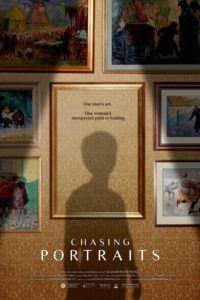
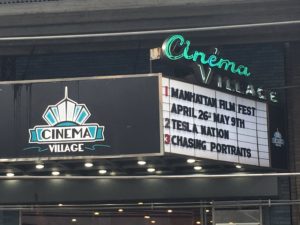
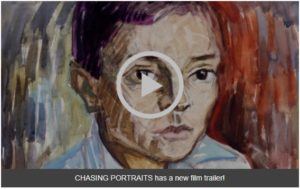
Although they have given some canvasses away as gifts over the years, their son still has a number of Moshe’s paintings at his home in Canada. Elizabeth is planning to visit him in October as part of a documentary she is making. The film is called “Chasing Portraits: A Family’s Quest for Their Lost Art Heritage.”

Elizabeth’s goal is not to buy back all of Moshe’s paintings, but rather to establish relationships with their new owners.

“Those people who have my great-grandfather’s artwork,” she said, “need to know what the larger story is and … understand that there are other paintings that were part of an original collection and … they have more meaning and importance when they are connected.”

She hopes that the paintings’ owners will preserve them, be willing to be a part of their story and perhaps loan the canvasses for an exhibit.

Elizabeth’s attempts to do an exhibit of Moshe’s work have been an uphill struggle. She has approached both Holocaust museums and Jewish art-history museums about displaying her great grandfather’s work.

The Holocaust museums typically reply that since the paintings are not about the Shoah, Moshe’s artwork is not a good fit for the museum. The curators from the Jewish fine art museums, on the other hand, tell Elizabeth that because Moshe’s is a Holocaust story, the paintings would be more relevant in a Holocaust museum.

“I feel that the Jewish community has a right to see the works,” Elizabeth said. “The Internet has been … a way to share it. …It’s great at leveling the playing field.” Not only does it allow her to show Moshe’s paintings to the world, it also lets her conduct the kind of thorough research that 20 years ago would have been nearly impossible.

“I know the collection will never be whole again,” Elizabeth said. “But I feel like I have to do everything I can to find what I can, because every time I find a new piece and learn another part of the story, it makes the collection that much more interesting and engaging.”

Visit www.rynecki.org for more information.

Chasing Portraits: A great-granddaughter’s search for her lost art legacy

I’m speaking in Boston on Thursday June 13th about the Moshe Rynecki paintings and story. If you’re interested in attending this event sponsored by Boston3G, check out the information on their website (http://boston3g.org/events/chasing-portraits-a-great-granddaughters-search-for-her-lost-art-legacy/):

Date/Time
Date(s) – June 13, 2013
7:30 pm – 9:30 pm

Location
Tremont on the Common

Chasing Portraits: A great-granddaughter’s search for her lost art legacy.

Moshe Rynecki (1881-­‐1943) painted the Polish-­Jewish community in the 1920s and 1930s. Although he perished in the Holocaust, many of his 800 works survived, and the Rynecki family has about 100. The artist’s great‐granddaughter will speak to Boston 3G about her great-grandfather, her quest to find the missing pieces, and where the family’s story rests within the larger story of Holocaust art restitution.

CLICK HERE to register for this event!


A Window to the Past

This week I have a guest blog over on Jewish Art Education’s website. The piece, “Moshe Rynecki: A Window to the Past” is a short piece – about 500 words – about the Moshe Rynecki project, with an emphasis on looking to the works as an opportunity for educators to use the pieces to broach issues of Jewish history, religious studies, art history, ethnicity, identity, and the Holocaust.  I’ll share it here too:

My great-grandfather, Moshe Rynecki (1881-1943), used his paintbrush and palette to chronicle the life of his community – the Jewish people of Poland. He painted Jewish worship and religious study, as well as cultural and lifetime milestones such as wedding celebrations and death. Most of all, he had a special affinity for portraying people at work in their everyday tasks. More than merely recording the scenes he painted, he features details that are often lost in the background of day to day life, illuminating and making plain the essence of his subjects. In painting a group of men sitting at a table studying the Talmud, Moshe highlights the Rabbi gesticulating as he speaks and men’s spines curved from hours of studying. Instead of showing a dark interior scene with a contrasting window, he emphasizes the window as the sole source of illumination, rays gently streaming from the window to highlight men reading the Talmud. His talent was to respectfully and intimately convey private moments of the world he knew and loved. His work is a window to the past, bringing back to life a people whose lives and culture were torn asunder.

I am pleased and proud to share my great-grandfather’s works with others because I believe his oeuvre of work opens interesting gateways for educators. The subjects of his pieces lend themselves to Jewish history, religious studies, art history, and ethnicity and identity issues. For example, Moshe often painted the religious community, but painted himself in western garb, more as ethnographer or observer than as part of the community he portrayed. The physical paintings open up an even more interesting discussion of Holocaust studies as they themselves have their own Holocaust story of separation, destruction, loss, and partial redemption.

Museum curators often think of the Moshe Rynecki story either as a Holocaust story or as the tale of a Jewish painter and his legacy of fine art. Today I believe there is an opportunity to reframe the entire discussion. As the world loses more Holocaust survivors, there are fewer people to bear witness and share their experiences, so there must be other ways to pass on their legacy. The children of survivors cannot speak for the survivors, but we can carry their stories forward. My great-grandfather once hoped his original collection of 800 paintings would be reassembled after the war, but that was not to be; my family has just over 100 paintings. I know the collection will never be whole again, but today I search for the lost and missing canvases and share the work we do have because his story, and the larger story of the paintings, is an important part of the Jewish cultural tapestry.

gyj_light

Moshe Rynecki on Facebook and Twitter

Want to see more, learn more, and hear more about Moshe Rynecki’s life, his art, and our 21st century projects?  “Like” us on Facebook or Follow us on Twitter.

Private Holdings – MRynecki paintings in Canada

In March 2008, we received a remarkable phone call.  A gentleman from Canada called to ask about our website and my grandfather’s memoir.  He said, “I read your book.  I think I have one of the paintings described in the book.”  He was referring to a description of a painting my grandfather wrote about in his memoir.  The passage from the book reads as follows:

My father was constantly painting.  When the Polish came to power he painted a painting, oil on canvas, which became a controversial one in Warsaw.  He created a Russian pogrom, an attack of the Cossacks on a synagogue in which raping of women was shown, dead men wrapped in the holy scrolls, a very strong political painting against the White Russians.  Of course the story of the Russian pogroms was well known, but had never been shown in a painting of such dramatic dimensions.

The man on the phone then told me the most incredible story:

My parents were Polish Jews.  During the Second World War they went into Russia and became partisan fighters.  At the end of the war they returned to Poland.  At one point during their journey they passed a farmhouse.  The farmer asked them, “are you Jewish?”  My parents told the farmer that, yes, they were Jewish.  The farmer said, “I always knew the Jews would return. I have this bundle of paintings showing Jewish life.  Do you want to buy these paintings?”  My parents bought the paintings, maybe about 50 works.  For many years my parents hung the paintings on the walls of their home.  Over the years they gave away different canvases to different people.  Today I have some, here in Canada.  My brother has some paintings as well; he’s in Israel.  We don’t know all the people that were given paintings over the years – my parents did not keep a list.  I recently decided to reframe one of the works and, on a whim, decided to Google the Rynecki name.  That’s how I found your website.

I was at a loss for words.  This man’s parents had saved a bundle.  They had protected, transported, cared for, and shared Moshe’s works with others.  I, of course, immediately wanted to see photographs of the paintings.  It wasn’t until 2012, four years later, that I was given photographs of those pieces. I’m quite excited to share them here with you!  The first painting displayed here, Russian Pogram – Attack of the Cossacks (by the way, I should make clear that all the titles of the paintings are ones I’ve created) is unlike anything I’ve ever seen by my great-grandfather.  And yet immediately I knew it was his work.  The style is all his.  Here are four photographs of the paintings held by the gentleman from Canada:

Russian Pogrom – Attack of the Cossacks


Religious Study at Table


Woodwork


Man and Girl on a Walk


Moshe Rynecki Paintings at the National Museum in Warsaw

For the last few months I have worked quite hard to track down several of my great grandfather’s paintings that I’d recently learned about.  I am still working on obtaining images from several different sources, but in the meantime am happy to enjoy gazing at images of two paintings I received from the Muzeum Narodowe w Warszawie (The National Museum in Warsaw).  As to how the Museum came to have the paintings in their possession, I was told that in 1963 an individual (a man) sold the paintings to the museum.  When pressed for more information (e.g., who was this man? how did he have the paintings? did he have others? what was his name?) I was told that the museum tried to contact him but that since their original contact with him was almost 50 years ago that they really were unable to find him and that they doubted he was still living.

I don’t think the Museum has these paintings on display on a regular basis.  I got the impression that they had to pull them out of storage to accommodate my request.  They kindly did so and had their photographer (Ligier Piotr) did take some really nice and high quality images.  I share those here with you:

W Parku (In a Park), 1935

Talmudysci (The Talmudists), undated

If you’re traveling to Warsaw, Poland, and you want to see the paintings, I’m guessing you’d have to call ahead and schedule a special viewing.  The inventory numbers for these paintings are: Rys.W.2146 and Rys.W.2145.  You can find them at the Muzeum Nardowe w Warszawie.  Let me know if you go and see them!  I’d love to hear about it.

An Open Letter Seeking Funding for Chasing Portraits, a Documentary Film Project

To Whom It May Concern:

I am writing to tell you about CHASING PORTRAITS: A Family’s Quest for their Lost Art Heritage, a documentary film project about my family’s quest for the lost, stolen, and missing paintings by my great-grandfather, Moshe Rynecki (1881-1943), and to ask for your funding assistance.

Moshe Rynecki painted the Jewish community in Warsaw, Poland in the 1920s and 1930s. He documented religious scenes (e.g. men studying the Talmud), images from everyday life (e.g., women doing household chores), and ultimately scenes from inside the Warsaw Ghetto. In 1939, when the Nazis invaded Poland, Moshe realized his life’s work was at great risk of being destroyed. In an effort to protect and preserve his paintings he bundled his collection of over 800 paintings into a number of packages and distributed them to gentile friends in and around Warsaw. He told his family where the paintings were hidden so that after the war the family [Read more...]